“AI is here to stay.”
Five words, delivered bluntly, almost in passing, inside a section on workforce development. It was the closest thing to an official AI doctrine in President Ferdinand Marcos Jr.’s fifth State of the Nation Address on Monday.
Not a policy. Not a target. A statement of fact, uttered as one might describe the weather or gravity—something no longer worth arguing over, only adapting to.
The statement framed the Department of Information and Communications Technology’s initiative to build “AI literacy across all sectors” in order to secure the country’s global competitiveness. Marcos reported that at least 1.8 million Filipinos have been trained on “high impact tech skills.”
“AI is here to stay,” he said, “and so we adopt it to harness its potential to enhance critical sectors, from our educational system to our industries.”
Moments later, Marcos offered his only other explicit AI mention, when he presented the Pax Silica Industrial Hub in New Clark City, a US-led economic security initiative with 23 signatories including the European Union as a bloc. The hub, he said, “will have AI at its core.”
Two mentions, two different registers. For enterprise observers, the speech outlined two distinct government tracks: one focused on workforce upskilling, and the other anchored in foreign-led capital projects.
A third passage never mentioned AI, an omission that stood out precisely because of how confidently the first two used it.
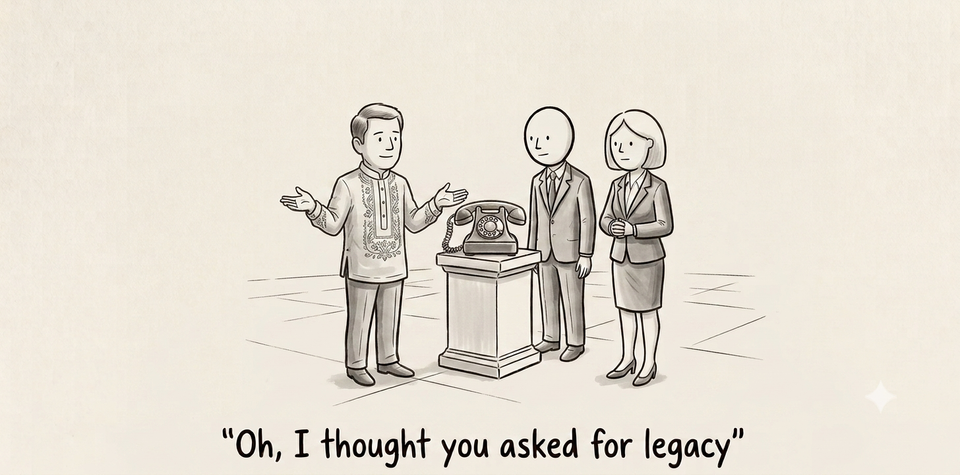
When Marcos praised the national disaster response system as “not only proactive, but predictive,” the term was notably absent. In current tech speak, predictive capability typically implies AI.
Whether or not that silence means machine learning is not really part of the stack yet, the speech itself does not say. After all, there is plenty of genuinely reliable forecasting that runs on legacy GIS mapping and statistical modeling, with no AI involved at all.
What it does highlight, however, is a state of things as relevant to corporate boardrooms as to the public sector: declaring AI is here to stay is easy; saying exactly where, and whether it actually improves what already works, is not.
Written by Oliver Ortega. Ada is an experiment in AI-enabled journalism. It uses generative AI for structural and conceptual brainstorming, drafting and language refinement, research and fact checking, and image generation. All analysis, editorial judgment, and final content are the author’s, who assumes full responsibility for what’s published.