
Currents
Tracking the most vital real-world trajectories of AI on business, policy, and labor
01
Aug
“AI is here to stay.”
In his fifth State of the Nation Address, President Marcos framed AI as unquestioned economic reality, but his deliberate omissions reveal the gap between national ambition and operational deployment.
Five words, delivered bluntly, almost in passing, inside a section on workforce development. It was the closest thing to an official AI doctrine in President Ferdinand Marcos Jr.’s fifth State of the Nation Address on Monday.
Not a policy. Not a target. A statement of fact, uttered as one might describe the weather or gravity—something no longer worth arguing over, only adapting to.
The statement framed the Department of Information and Communications Technology’s initiative to build “AI literacy across all sectors” in order to secure the country’s global competitiveness. Marcos reported that at least 1.8 million Filipinos have been trained on “high impact tech skills.”
“AI is here to stay,” he said, “and so we adopt it to harness its potential to enhance critical sectors, from our educational system to our industries.”
Moments later, Marcos offered his only other explicit AI mention, when he presented the Pax Silica Industrial Hub in New Clark City, a US-led economic security initiative with 23 signatories including the European Union as a bloc. The hub, he said, “will have AI at its core.”
Two mentions, two different registers. For enterprise observers, the speech outlined two distinct government tracks: one focused on workforce upskilling, and the other anchored in foreign-led capital projects.
A third passage never mentioned AI, an omission that stood out precisely because of how confidently the first two used it.
When Marcos praised the national disaster response system as “not only proactive, but predictive,” the term was notably absent. In current tech speak, predictive capability typically implies AI.
Whether or not that silence means machine learning is not really part of the stack yet, the speech itself does not say. After all, there is plenty of genuinely reliable forecasting that runs on legacy GIS mapping and statistical modeling, with no AI involved at all.
What it does highlight, however, is a state of things as relevant to corporate boardrooms as to the public sector: declaring AI is here to stay is easy; saying exactly where, and whether it actually improves what already works, is not.
Written by Oliver Ortega. Ada is an experiment in AI-enabled journalism. It uses generative AI for structural and conceptual brainstorming, drafting and language refinement, research and fact checking, and image generation. All analysis, editorial judgment, and final content are the author’s, who assumes full responsibility for what’s published.
Policy
31
Jul
Buy, lease, or stagnate
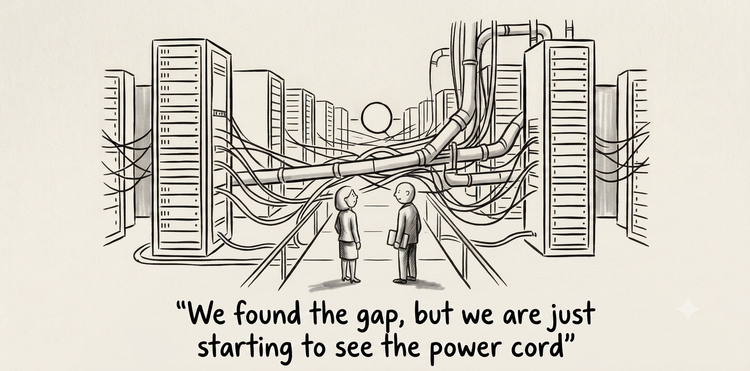
Enterprise data shows infrastructure as the primary barrier to scaling AI adoption. Addressing the gap, however, is not as easy as it may seem.
Philippine enterprises are facing an aggressive push to upgrade their infrastructure with the arrival of AI.
At the second Practical Insights, organized by ST Telemedia Global Data Centres, Chief Revenue Officer Chris Street identified infrastructure—raw compute, storage, bandwidth, etc.—as the “main barrier” to scaling AI adoption.
It is an understandable diagnosis from a firm expanding data center footprints. However, it is a consensus sourced from over 600 enterprise and digital-native leaders across nine Asian markets.
According to STT GDC’s joint study with Ecosystm published in April, Mind the Gap: Bridging the AI Infrastructure Readiness Divide, close to 90% of surveyed organizations have launched an AI project, yet very few have successfully transitioned from pilot tests into production environments. Many were classified as Builders, deploying AI at a very limited scale.
In the Philippines, 71% of organizations point not just to infrastructure, but also to talent and connectivity constraints, as to why 79% are stuck in the Builder phase.
These numbers may not seem new, as we have probably come across them when the report was first publicized by STT GDC early this year. What is new, perhaps, is twofold.
First, Street emphasized the Philippines as being in the same boat as the rest of Southeast Asia—that our AI readiness situation is not different from everyone else. Second, Street positions the country as ahead of the regional average, due largely to a citizenry that is more digitally inclined, a nation trained by its appetite for social media, e-commerce, and the like.
“The Philippines is a great place in terms of digital, and it always has been,” Street sums it rather encouragingly.
Other industry leaders who spoke at Practical Insights, none from STT GDC, separately affirmed the importance of foundational infrastructure as key to achieving AI-driven business ambitions. Each made the case for buying or leasing—access advanced models through hyperscalers, find the right partner, and lease colocation capacity tied to measurable business value, if running cloud or data centers is not your primary domain.
Later, as I was lining up for lunch, I curiously asked an STT GDC officer if scaling AI infrastructure is possible without purchasing capacity from a vendor. Her answer was straightforward: building it yourself is certainly doable, though likely more costly and falls outside most enterprises’ core business.
Come to think of it, the buy-or-build question is not really new and rarely that simple. Practically everyone has gone through it, like a rite of passage on the way to automating almost anything.
Swarm’s Philippine AI Report 2025 recommended building what one needs to own for the long haul and borrowing where speed matters most. Today’s technology is a target that is moving too fast, and accelerating progress is only possible if one can keep up, which makes engaging an external partner unavoidable.
Perhaps this is the real practical insight from the forum—not just how much rack space an enterprise should lease, but for what purpose, and whether their data architecture and team workflows are mature enough to utilize that capacity efficiently once the contract begins.
—
Written by Oliver Ortega. Ada is an experiment in AI-enabled journalism. It uses generative AI for structural and conceptual brainstorming, drafting and language refinement, research and fact checking, and image generation. All analysis, editorial judgment, and final content are the author’s, who assumes full responsibility for what’s published.
Infrastructure
30
Jul
Revisiting the ILO data on ASEAN AI and labor
Mainstream headlines from the ILO AI report are rightly focused on labor market disruption. But the data reveals a far more urgent operational gap and one that is disproportionately hitting MSMEs.
When the International Labour Organization (ILO) released its report on generative AI and ASEAN labor markets on July 9, most coverage centered on national exposure rankings and potential labor displacement, with the Philippines ranking second in AI exposure, just behind Singapore.
Less noticed in the same brief is another ranking that complicates that narrative. Layering its exposure estimates onto the International Monetary Fund’s (IMF) 2023 AI Preparedness Index, it found that the Philippines ranked fourth in overall readiness.
This asymmetry suggests that future labor market outcomes will depend not only on where exposure happens, but on institutional, digital, and policy capacity, at least according to the ILO. For business leaders, meanwhile, this highlights a massive execution gap between AI exposure and actual enterprise deployment.
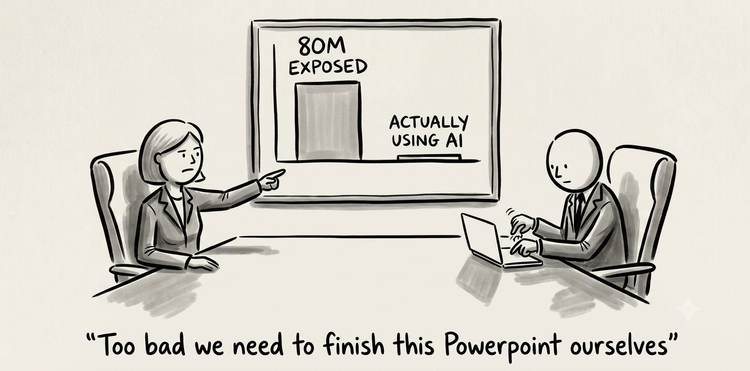
Macro data from the study does not yet show any widespread AI-driven labor crisis in ASEAN. In fact, employment in the region’s most exposed roles continues to expand. Occupations with GenAI exposure have grown steadily—from 66 million workers (20.9% of total employment) in 2017, to 74 million (22.2%) in 2022, to nearly 80 million (22.9%) by 2025—maintaining an upward trajectory both before and after the commercial release of ChatGPT in 2022.
As the ILO notes, these numbers “reflect the fact that AI adoption still remains at an early stage.” While firm-level data across ASEAN remains limited, the report presented a 2026 Singapore Ministry of Manpower survey which showed that 71.5% of firms have not begun AI adoption at all, and only 3.8% have integrated it into core business processes.
The adoption gap splits sharply by enterprise size too: 76.4% of firms with over 500 employees have adopted AI, compared to 23.9% of businesses with fewer than 25 employees.
While Singapore’s economy differs from the Philippines or its other regional neighbors, the pattern aligns with ILO’s broader finding—that AI integration is concentrated in a few large corporations. The majority of businesses—micro, small, and medium enterprises (MSMEs)—by contrast, largely lack the capital and technical resources to follow at the same pace.
A similar mismatch appears in platform-level metrics. Citing Anthropic’s Claude usage data in the region from February 2026, the report finds that active GenAI usage is heavily concentrated in software development and technology-intensive roles. Office and administrative support functions, despite ranking among the most exposed occupations, show comparatively little actual usage.
ILO notes that this reflects usage of a single platform, not the wider market. Two recent IMF studies on AI exposure and complementarity, covering Singapore (2024) and the Philippines (2025), offer a sharper picture:
• High complementarity (augmentation by AI): Managers and supervisors, scientists and engineers, healthcare workers, legal professionals, and educators stand to gain from AI as a complement to their work.
• Low complementarity (at risk of substitution): Accountants and auditors, secretaries, administrative clerks, customer service representatives, telemarketers, and routine ICT professionals face a significantly higher risk of being replaced by AI.
In other words, the tools to automate high-exposure, low-complementarity tasks, and cut labor costs, are not hypothetical or forthcoming; they already exist, sitting mostly unused across enterprises the ILO surveyed.
The absence of visible labor disruption in today’s macro data does not mean that AI will have no impact tomorrow. Instead, the numbers point directly to where workflows will inevitably evolve. For leadership teams, it is simply a matter of choosing when to reengineer those workflows, before competitors, clients, or time force the decision.
—
Written by Oliver Ortega. Ada is an experiment in AI-enabled journalism. It uses generative AI for structural and conceptual brainstorming, drafting and language refinement, research and fact checking, and image generation. All analysis, editorial judgment, and final content are the author’s, who assumes full responsibility for what’s published.
Labor
22
Jun
[HBR] AI agents around implicit company rules
Designing enterprise AI agentic systems requires mapping implicit, unwritten cultural rules of an organization.
- Executives must ensure AI mirrors local workplace dynamics and relational hierarchies to avoid friction.
- Auditing workflows for unwritten norms prevents expensive integration failures in legacy structures.
Use Case
22
Jun
[GovInsider] DICT to introduce AI agents
DICT is set to embed AI agents into national digital platforms to streamline public services.
- AI-driven digitisation will reduce bureaucratic friction, accelerating public-private transactions.
- Enterprises should prepare stacks to integrate with automated government APIs and digital registries.
Infrastructure