Revisiting the ILO data on ASEAN AI and labor
When the International Labour Organization (ILO) released its report on generative AI and ASEAN labor markets on July 9, most coverage centered on national exposure rankings and potential labor displacement, with the Philippines ranking second in AI exposure, just behind Singapore.
Less noticed in the same brief is another ranking that complicates that narrative. Layering its exposure estimates onto the International Monetary Fund’s (IMF) 2023 AI Preparedness Index, it found that the Philippines ranked fourth in overall readiness.
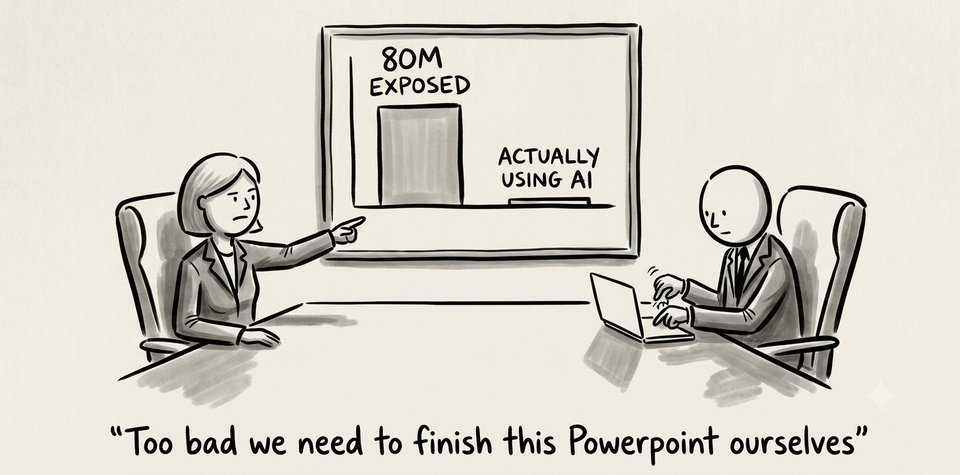
This asymmetry suggests that future labor market outcomes will depend not only on where exposure happens, but on institutional, digital, and policy capacity, at least according to the ILO. For business leaders, meanwhile, this highlights a massive execution gap between AI exposure and actual enterprise deployment.
Macro data from the study does not yet show any widespread AI-driven labor crisis in ASEAN. In fact, employment in the region’s most exposed roles continues to expand. Occupations with GenAI exposure have grown steadily—from 66 million workers (20.9% of total employment) in 2017, to 74 million (22.2%) in 2022, to nearly 80 million (22.9%) by 2025—maintaining an upward trajectory both before and after the commercial release of ChatGPT in 2022.
As the ILO notes, these numbers “reflect the fact that AI adoption still remains at an early stage.” While firm-level data across ASEAN remains limited, the report presented a 2026 Singapore Ministry of Manpower survey which showed that 71.5% of firms have not begun AI adoption at all, and only 3.8% have integrated it into core business processes.
The adoption gap splits sharply by enterprise size too: 76.4% of firms with over 500 employees have adopted AI, compared to 23.9% of businesses with fewer than 25 employees.
While Singapore’s economy differs from the Philippines or its other regional neighbors, the pattern aligns with ILO’s broader finding—that AI integration is concentrated in a few large corporations. The majority of businesses—micro, small, and medium enterprises (MSMEs)—by contrast, largely lack the capital and technical resources to follow at the same pace.
A similar mismatch appears in platform-level metrics. Citing Anthropic’s Claude usage data in the region from February 2026, the report finds that active GenAI usage is heavily concentrated in software development and technology-intensive roles. Office and administrative support functions, despite ranking among the most exposed occupations, show comparatively little actual usage.
ILO notes that this reflects usage of a single platform, not the wider market. Two recent IMF studies on AI exposure and complementarity, covering Singapore (2024) and the Philippines (2025), offer a sharper picture:
• High complementarity (augmentation by AI): Managers and supervisors, scientists and engineers, healthcare workers, legal professionals, and educators stand to gain from AI as a complement to their work.
• Low complementarity (at risk of substitution): Accountants and auditors, secretaries, administrative clerks, customer service representatives, telemarketers, and routine ICT professionals face a significantly higher risk of being replaced by AI.
In other words, the tools to automate high-exposure, low-complementarity tasks, and cut labor costs, are not hypothetical or forthcoming; they already exist, sitting mostly unused across enterprises the ILO surveyed.
The absence of visible labor disruption in today’s macro data does not mean that AI will have no impact tomorrow. Instead, the numbers point directly to where workflows will inevitably evolve. For leadership teams, it is simply a matter of choosing when to reengineer those workflows, before competitors, clients, or time force the decision.
—
Written by Oliver Ortega. Ada is an experiment in AI-enabled journalism. It uses generative AI for structural and conceptual brainstorming, drafting and language refinement, research and fact checking, and image generation. All analysis, editorial judgment, and final content are the author’s, who assumes full responsibility for what’s published.